We built an electrical substation inside XINTRA, then we hacked it by simulating a Sandworm (APT44, ELECTRUM, Telebots, IRON VIKING, BlackEnergy) inspired attack.
Most electricity transmission and distribution network providers do not allow disruptive penetration tests on a live power grid. But defenders still need to understand how an attacker could reach operational systems, what they could disrupt and where intervention could stop them.
We wanted to examine that progression in a controlled environment, from an initial compromise to an operational consequence. Our scenario crossed from IT into OT, reached an engineering workstation and triggered an emergency trip. All 12 circuit breakers opened, interrupting supply in the electrical model.
We simulated both the intrusion and the disruption of electricity and this blog is how we built the environment and what the attack revealed.

Simulating an electrical substation
We built a representative IEC 61850 conventional substation and its supporting IT and OT infrastructure, informed by threat intelligence on Sandworm's operations and the expertise of our in-house Senior OT Architect, Ramin (hey 🙂).
For our scenario, we separated IT and OT workloads onto different networks and placed a firewall between the networks. The only permitted communication across that boundary was through the historian infrastructure.
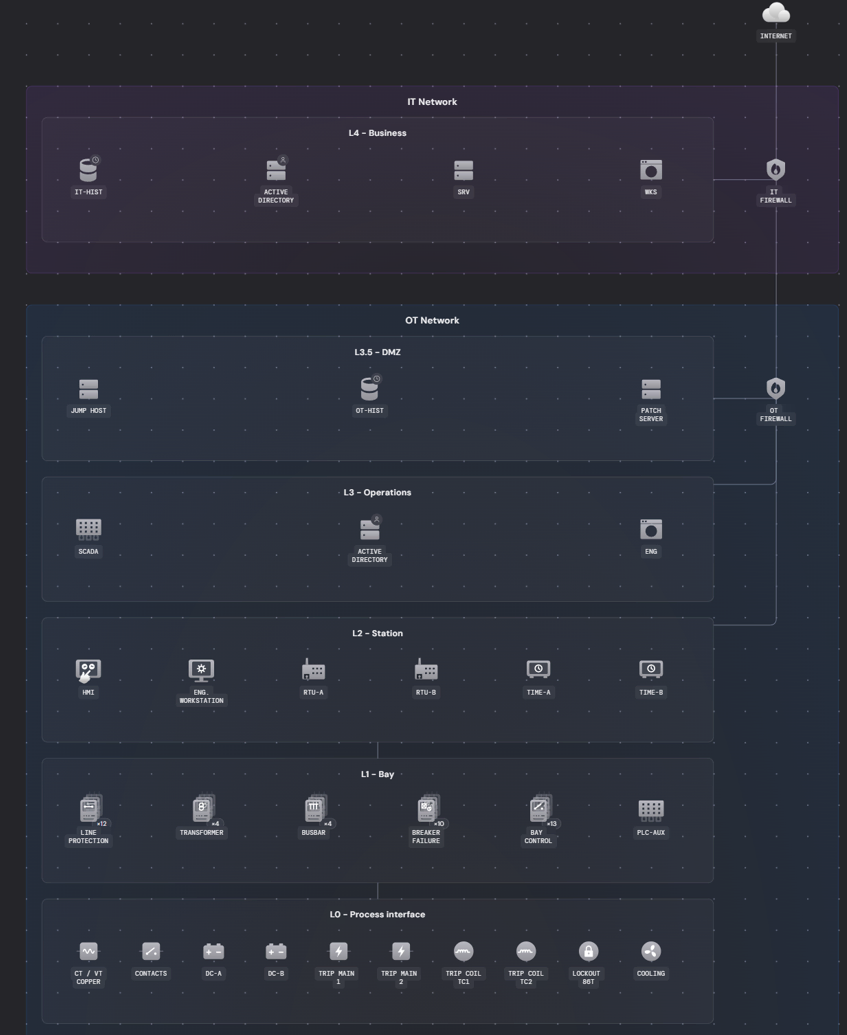
The OT environment was comprised of:
- DMZ: jump host, OT historian and patch server.
- Layer 3 Operations: SCADA, OT Active Directory and engineering server.
- Layer 2 Station: HMI, engineering workstation, RTU gateways (RTU-A and RTU-B) and time synchronization servers.
- Layer 1 Bay: Line protection relays, transformers, busbars, breaker failure protection, bay controllers and auxiliary PLCs.
- Layer 0 Process Interface: CT/VT measurements, contacts, DC power supplies, trip circuits, lockout relays and auxiliary systems.
Modelling the electrical response
The environment runs a continuously evaluated time-domain electrical model of a 500/330 kV breaker-and-a-half substation, containing:
- 12 circuit breakers.
- 24 disconnectors and 12 earth switches.
- A 500 MVA transformer bank with a 33-position tap changer.

A SCADA master communicates with the model using IEC 60870-5-104 over TCP/2404. Operational events are recorded in a PostgreSQL historian and replicated across the IT/OT boundary.
Breaker and switch commands drive modelled transitions through open, intermediate and closed. Interlocking sits in the bay controllers, and protection trips come from the relays rather than from the plant model.
The model is paced to real time and keeps station time aligned with the time servers.
Running the attack
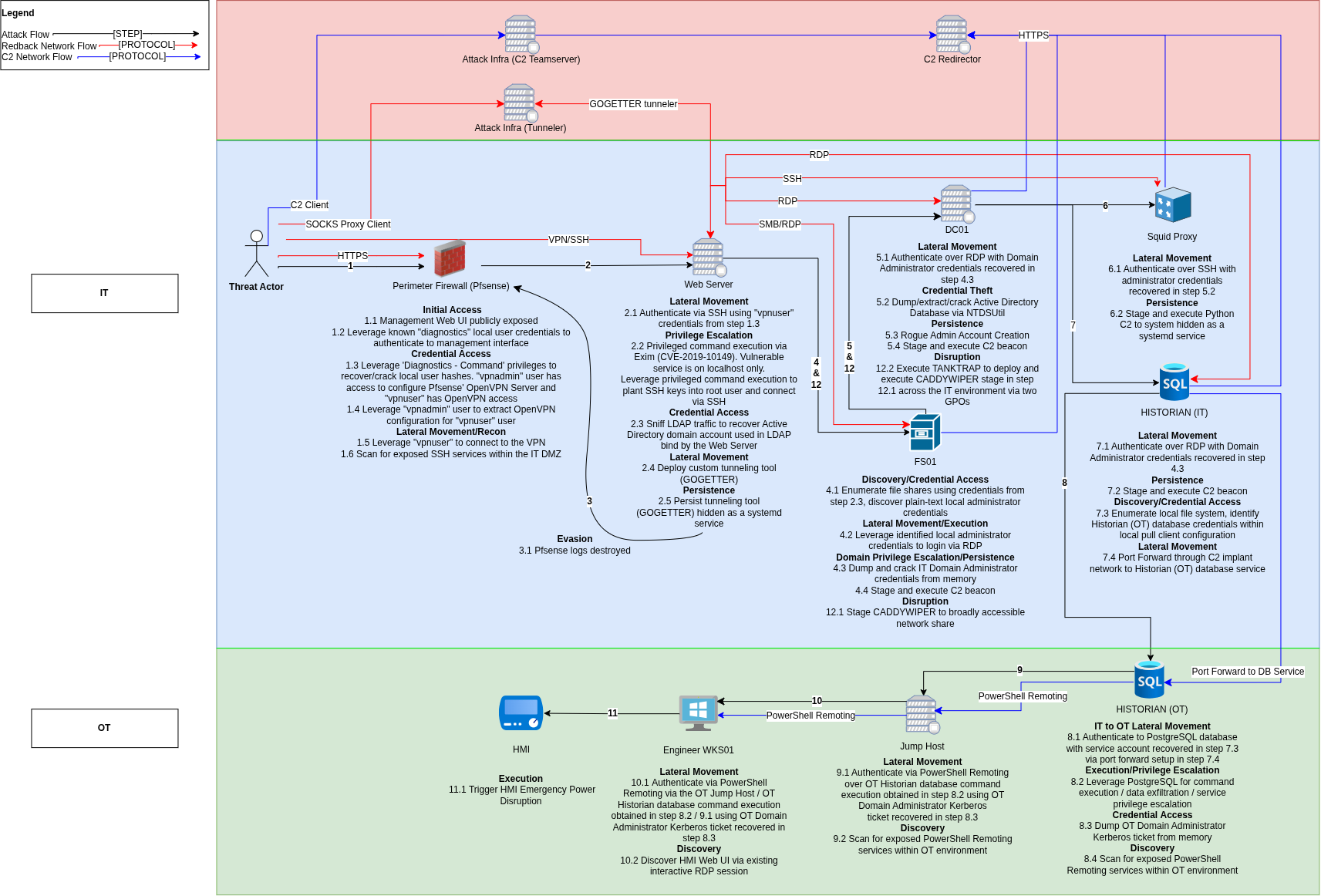
With the substation running in XINTRA Twin, we designed a Sandworm inspired attack adapted to our modernized IT and OT architecture in three main phases:
- Compromise the perimeter firewall (edge device compromise)
- Cross into OT through the historian (jumping from IT)
- Reach the HMI and interrupt electricity supply
The diagram shows the individual steps. Three connections in that chain explain how the attack reached the substation controls.
Phase 1: Edge device compromise as initial access
Firewalls and VPN appliances are established entry points for state-sponsored attackers. CISA has documented Volt Typhoon exploiting perimeter appliances, recovering credentials and using VPN connections to maintain access to critical infrastructure networks.
Our scenario started with a compromise of the perimeter firewall. Its administrative permissions exposed further authentication material, enabling VPN access to IT. Credentials recovered inside the network then opened the path to the domain controller and historian. This allowed full attacker takeover of the IT network.
Phase 2: Compromise the Historian for IT to OT hop
Historian replication lets businesses use operational data while keeping IT and OT separate. Current joint guidance recommends replicating OT data into a DMZ through a secure, unidirectional mechanism, without inbound connectivity from IT into OT.
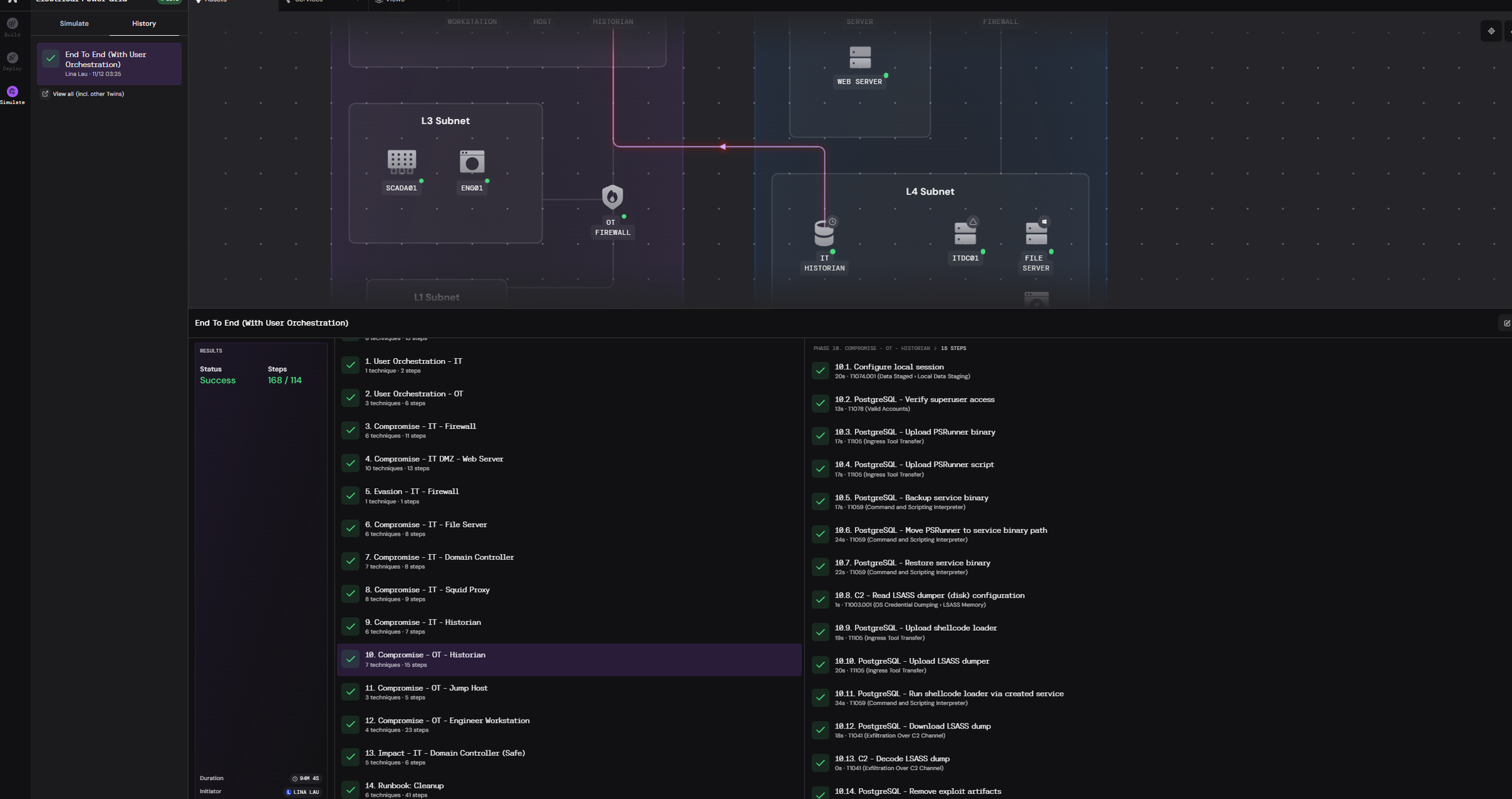
Our configuration allowed the IT historian to connect to the OT historian's database. Stored credentials, excessive database privileges and an elevated scheduled task turned that permitted connection into a route for compromise.
The weakness was in how we implemented the data exchange. The firewall separated the networks, but the historian connection still allowed the attacker through. This phase of the attack resulted in us jumping from the IT network into the segmented OT network.
Phase 3: Disrupting the electricity supply
After compromising the OT network, we discovered an engineering workstation. From the engineering workstation, we reached the HMI and triggered its emergency-trip function. All 12 circuit breakers across the 500 kV and 330 kV switchyards transition from CLOSED to OPEN.
For this scenario, the critical defensive opportunities came before that command (preventing the crossing into OT, restricting movement within OT and protecting access to the operator session). Once those controls had been passed, an existing HMI function was enough to cause the disruption.
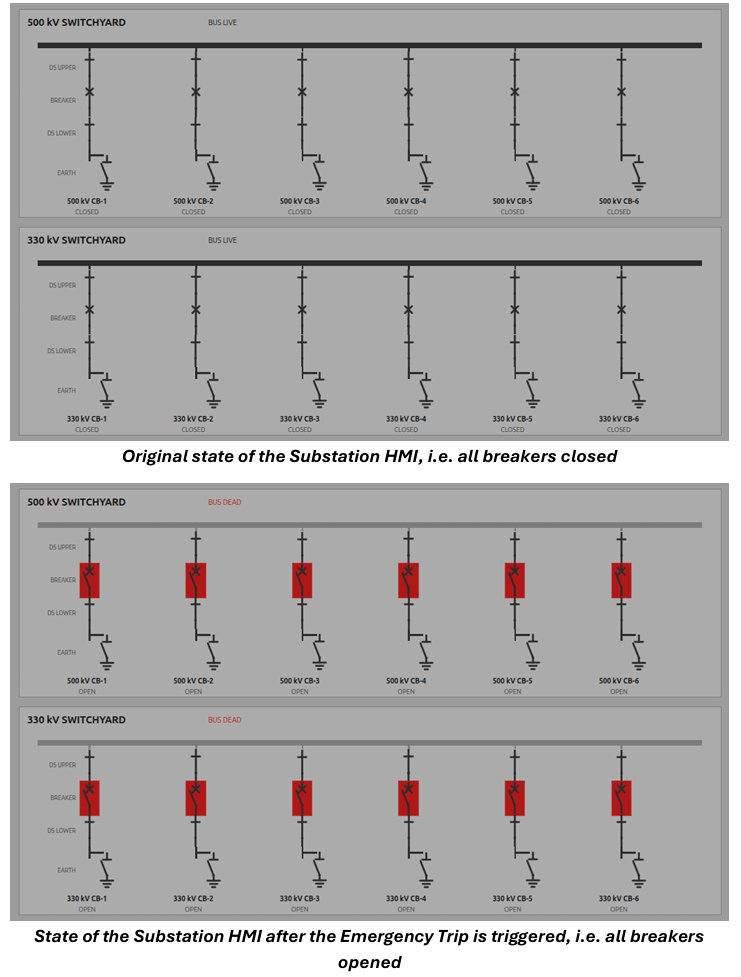
The simulation connected three distinct layers: the IT/OT compromise path, the attacker's ability to operate an industrial HMI, and the physical-process consequence represented in the simulated electrical model.

Why we simulated this
Attacks on energy infrastructure continue to produce operational consequences. In December 2025, attackers damaged controllers and disrupted communications at renewable energy sites in Poland. Another incident during the same campaign shut down a steam turbine and water treatment system at a heat and power plant.
Sandworm has repeatedly demonstrated this threat in Ukraine. Its December 2015 attack left approximately 225,000 customers without electricity for one to six hours. Industroyer interrupted power in part of Kyiv in December 2016, and another Sandworm operation caused an outage in October 2022.
Defenders need somewhere to test these scenarios. Disruptive testing on live OT networks risks essential services, while a dedicated physical lab requires specialist equipment, expertise and significant investment. We built XINTRA Twin to give defenders a place to model complex infrastructure, simulate attacks and test their defences against the resulting operational consequences.